Personalized Medical Care & Dedicated International Patient Concierge


Scalp Micropigmentation (SMP) · Consultation Required
SMP Hairline
SMP hairline treatment applies this technique specifically to the frontal hairline — the area that frames the face and is usually the first thing both the patient and other people notice.
Schedule a ConsultationWhat Is SMP Hairline Treatment? Scalp Micropigmentation Explained

SMP stands for Scalp Micro Pigmentation. It is a scalp pigment therapy in which extremely fine micro-dots of pigment are deposited into the scalp to create the visual impression of hair follicles where hair has thinned or receded. SMP hairline treatment applies this technique specifically to the frontal hairline — the area that frames the face and is usually the first thing both the patient and other people notice.
The technique did not begin as a cosmetic procedure. Scalp micropigmentation was originally developed and attempted as a medical tattoo for covering scalp conditions and scalp scarring. Only later did it become widely adopted for aesthetic purposes such as hair loss coverage, which is how it evolved into the scalp pigmentation therapy patients ask for today. That medical origin is precisely why Return Clinic performs SMP inside a clinic setting rather than a beauty studio.
At Return Clinic, SMP hairline treatment is a non-surgical procedure. Nothing is cut, transplanted, or implanted. A micro-needle deposits pigment in micro-unit dots shaped to resemble the patient's own follicular roots as closely as possible, so the eye reads density where density has been lost. The result is a visual effect — the appearance of hair roots — rather than the creation of new hair.
How SMP hairline treatment differs from other hair loss options
SMP occupies a distinct position among hair restoration approaches, and understanding that position helps patients choose correctly.
- It is non-surgical: There is no incision, no graft harvesting, and no surgical recovery period. Patients can generally return to ordinary daily activity immediately after the session.
- It does not depend on donor hair: Because SMP creates a visual impression rather than moving follicles, it remains available to patients whose hair loss is too advanced for transplantation, and to patients with shaved or fully bald scalps.
- It works with hair transplantation rather than against it: SMP is designed to avoid damaging the scalp or stimulating follicles and hair root cells, so it does not interfere with grafts, with future hair loss progression in other areas, or with new growth.
- It is not age- or gender-restricted: SMP is applied for both partial hair loss and total hair loss, and it has become especially popular among women dealing with thinning at the hairline, part line, and crown.
This is not a claim that SMP is superior to medical hair loss therapy or hair transplantation. Each approach addresses a different problem. Medication and transplantation aim to preserve or relocate biological hair; SMP addresses the visual density of the scalp. Many patients ultimately use them together, and your consulting physician will help you understand which combination is appropriate for your situation.
Why the hairline specifically?
The hairline determines the perceived proportion of the face. When the frontal hairline recedes, the forehead reads as larger and the face reads as longer — which is why patients who complete hairline SMP frequently report that their face looks smaller and that they appear somewhat younger. A well-designed hairline is not simply a line drawn lower on the forehead. It requires irregularity, asymmetry within natural limits, soft density gradation at the leading edge, and directional logic that matches how hair actually emerges from the scalp.
Who Needs SMP Hairline Treatment? Ideal Candidates for Scalp Micropigmentation
SMP hairline treatment is best suited to people who are troubled by how their hairline looks and who want a non-surgical option that carries minimal disruption to daily life. Because the treatment is not age- or gender-restricted and does not depend on remaining donor hair, the candidate profile is unusually broad. The following patterns are the ones most frequently seen in the SMP hairline consultation room.
- Adults in their 20s through 60s with M-shape hair loss: This is recession at both temple corners, where the hairline retreats on either side of the forehead and gradually forms an M shape. It is one of the most common presentations we treat, and because it is confined to defined zones at the frontal margin, it often responds well to targeted hairline SMP.
- Patients with irregular partial hair loss along the hairline: Some thinning is diffuse and subtle enough that patients do not initially recognise it as hair loss at all — the hairline simply becomes vague, patchy, or less defined over time. Micro-dot pigmentation can fill these irregular gaps and re-establish a clean, believable leading edge.
- Patients with an asymmetric hairline: When one side of the hairline sits higher or thinner than the other, styling becomes restrictive: hair cannot be swept freely, partings must be hidden, and certain hairstyles become impossible. Correcting asymmetry through SMP is frequently as much about restoring styling freedom as it is about density.
- Women with hairline, part-line, and crown thinning: Female-pattern thinning tends to concentrate exactly in these zones, and it is a source of real distress that is often minimised by others. SMP has become one of the most requested treatments for this concern precisely because it addresses the visible scalp show-through without surgery.
- Patients preparing for, or recovering from, hair transplantation: During the graft settling period, SMP-created root effect supplements density in the interim, and the combined effect can read as fuller and more closely packed than either approach alone. This is a planned synergy, discussed with your physician, not an improvisation.
- Patients whose hair loss is too advanced for transplantation, including fully shaved or bald scalps: Where grafting is not a realistic option, medical tattooing can still create the natural appearance of hair roots across the scalp. Patients in this group often mention two secondary effects: the face appears smaller, and the overall impression is somewhat more youthful.
- Patients with scalp scarring or scalp conditions requiring camouflage: This is the original clinical application of SMP and remains part of our scope.
- Patients who want a low-maintenance, non-surgical option. SMP requires no daily application, no recovery leave, and no ongoing procedural commitment beyond the planned session series and periodic maintenance.
Who should reconsider or delay treatment: If your scalp is currently inflamed, infected, broken, or actively treated for a dermatological condition, treatment should be deferred until the scalp has settled. If you are in the middle of a rapidly progressing episode of hair loss, your physician may recommend stabilising the underlying condition first so that the SMP design can be planned against a predictable baseline. And we do not recommend excessive or forced treatment: if the honest clinical answer is that SMP will not meaningfully help you, we will tell you so at consultation.
If you notice sudden, patchy, or rapid hair loss accompanied by scalp pain, sores, bleeding, or systemic symptoms, seek medical evaluation promptly rather than proceeding directly to a cosmetic scalp procedure. Hair loss can occasionally be a sign of an underlying medical condition that requires diagnosis and treatment in its own right.
Meet the Medical Team Behind SMP Hairline Treatment at Return Clinic
SMP at Return Clinic is delivered inside a physician-led medical clinic, and that governance structure is central to how the service is run — from sterilisation standards to the decision about whether a patient should be treated at all.
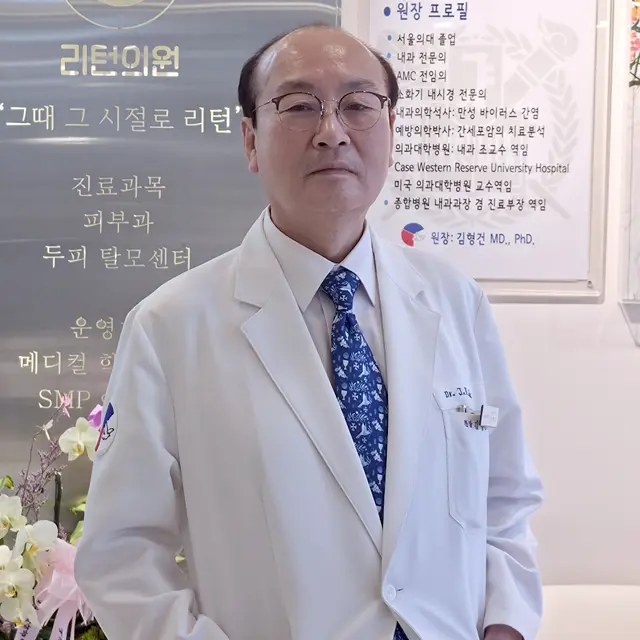
Dr. Hyung Geon Kim, M.D., Ph.D. — Medical Leadership
Dr. Kim is a board-certified Internal Medicine specialist and a certified Gastrointestinal Endoscopy subspecialist. He is a graduate of Seoul National University College of Medicine, holds a Master's Degree in Internal Medicine with research on chronic viral hepatitis, and a Ph.D. in Preventive Medicine with research analysing hepatocellular carcinoma treatment. He completed fellowship training at Asan Medical Center (AMC) and has served as Assistant Professor in the Department of Internal Medicine at a medical university hospital, as Professor at Case Western Reserve University Hospital in the USA, and as both Chief of Internal Medicine and Medical Director of a general hospital. His clinical specialties include liver disease — chronic hepatitis B and C, liver cirrhosis, and fatty liver disease — the diagnosis and treatment of hepatocellular carcinoma, general gastrointestinal disorders, and upper and lower endoscopy for diagnosis and treatment. He is certified as a Gastrointestinal Endoscopy Subspecialist by the Korean Society of Gastrointestinal Endoscopy (Certification No. 99-533, valid 1 August 2025 – 31 July 2030) and is a member of that society.
Dr. Kim's specialty training is in internal medicine and gastroenterology rather than in scalp pigmentation itself. What his background contributes to this service is institutional: a physician-directed standard of infection control, procedural documentation, patient screening, and clinical conservatism carried over from hospital and academic practice. Decades of work in procedure-based medicine — where sterile technique, single-use instrumentation, depth control, and patient selection are non-negotiable — is exactly the discipline a scalp procedure performed in a clinic should be held to.
The SMP Practitioner Team
The hands-on SMP hairline procedure is carried out by experienced practitioners with extensive procedural volume in scalp micropigmentation. Their expertise is specific and technical: reading the correct depth and angle of pigment placement within the scalp's skin layers, adjusting dot size and treatment direction according to each individual's follicle shape, and assessing how each patient's scalp actually takes colour. That combination of experience and per-patient assessment is what allows treatment to be delivered precisely and meticulously, and it is the primary safeguard against the pigment migration and blur that poorly controlled scalp tattooing can produce.
Shared care philosophy. The team's shared commitment is conservative, communication-led, patient-first care: treat only what genuinely benefits the patient, build results gradually across sessions rather than forcing them in one, and never perform a procedure that could compromise the patient's future hair restoration options.
SMP Hairline Treatment Areas and Expected Improvements
SMP is applied both to a single defined area and to the scalp as a whole. Return Clinic's medical tattoo approach reproduces the irregularity that arises from each individual's scalp characteristics, and matches treatment density and pattern to the colour and thickness of that patient's own hair. The following are the areas most commonly addressed within hairline-focused treatment and its adjacent scope.
- Frontal hairline (primary treatment area): This is the leading edge of the scalp that frames the face and defines forehead proportion. Treatment here is the most design-sensitive work we do, because the eye is unforgiving about an unnatural front edge. Rather than drawing a uniform line, the practitioner builds a soft, irregular, gradated margin using varied dot sizes and spacing so that density increases progressively as it moves back from the front edge — the way a natural hairline actually behaves.
- M-shape temple recession: The corners of the frontal hairline recede on both sides of the forehead and progressively form an M shape, and this is one of the most frequently requested SMP targets. Treatment here restores the corner geometry that has been lost, softening the depth of the recession points and re-establishing a more rectangular frontal frame. Because the temple area sits at the transition between hairline and side hair, dot direction and density must be blended carefully in two directions at once.
- Irregular partial thinning within the hairline: Not all hairline loss recedes cleanly; much of it thins in scattered, uneven patches that patients often do not initially identify as hair loss. Micro-dot pigmentation fills these gaps selectively, reinforcing density only where the scalp shows through and leaving well-covered zones untouched. This selective approach is what keeps the treated area reading as genuinely irregular rather than uniformly filled in.
- Asymmetric hairline: When the two sides of the hairline sit at different heights or densities, hair becomes difficult to sweep or part freely, and styling options narrow considerably. SMP balances the two sides by adding perceived density to the weaker side rather than by cutting the stronger one down. Patients frequently describe the outcome less in terms of density and more in terms of regained freedom to style their hair as they want.
- Part line and crown (adjacent scope): Widening of the part line and thinning at the crown are extremely common in women and are often the first place scalp show-through becomes visible under overhead lighting. Pigmentation reduces the contrast between pale scalp and darker hair, which makes the scalp far less conspicuous in exactly the lighting conditions patients dread. This area is frequently combined with hairline work in a single treatment plan.
- Full-scalp coverage for advanced or complete hair loss (adjacent scope): For patients with hair loss severe enough to make transplantation difficult, and for those with fully bald scalps, medical tattooing can create the natural appearance of hair roots across the entire scalp. Beyond density itself, patients often report that this makes the face appear smaller and the overall impression somewhat younger.
- Scalp scarring and scalp condition camouflage: Covering scalp conditions and scalp scarring was the original medical application of scalp micropigmentation before it became popular for cosmetic hair loss coverage. Pigment is matched to surrounding tone to reduce the visual contrast of the scar area.
Expected improvements
Patients most commonly experience improvement in the appearance of hairline density, sharper and more intentional hairline definition, reduced scalp show-through under direct or overhead light, softened contrast between scalp and hair colour, less visible asymmetry, and greater freedom in hairstyle choice. Where the hairline is re-established across a receded forehead, the proportional effect can make the face appear smaller and the overall impression somewhat more youthful.
Results vary from person to person. Colour uptake, scalp sensitivity, skin condition, hair colour and thickness, existing hair loss pattern, and aftercare all influence the final appearance, and no specific outcome can be guaranteed. Your practitioner will assess your individual scalp condition at consultation and give you a realistic account of what SMP can and cannot achieve in your case.
SMP Hairline Treatment Process and Timeline: What to Expect
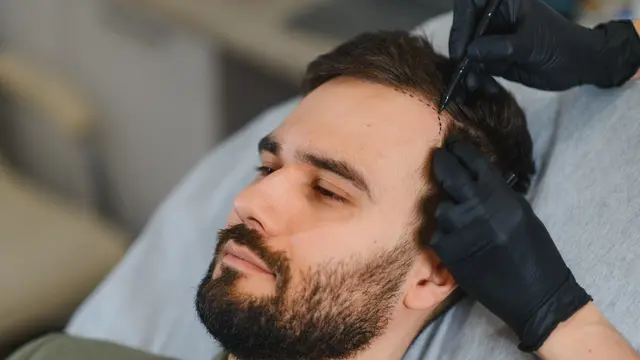
SMP hairline treatment is deliberately delivered across multiple sessions rather than in one sitting. Splitting treatment into several rounds may be slightly less convenient, but it is clinically necessary: colour uptake differs according to each individual's sensitive scalp condition, and dot size and treatment direction must be set according to the shape of each patient's hair roots. Dividing the work allows the team to communicate sufficiently with the patient and confirm results as they build.
- Consultation and scalp assessment: Your scalp condition, hair loss pattern, hair colour and thickness, skin tone, and treatment goals are assessed. The practitioner examines whether your scalp is suitable for treatment now, and discusses whether SMP alone, or SMP alongside other hair restoration approaches, is the appropriate route. If you are planning hair transplantation, tell us at this stage so the plan can be sequenced correctly. If treatment is not advisable for you, we will say so — we do not recommend excessive or forced procedures.
- Hairline design and pigment matching: The proposed hairline shape is designed on your scalp and reviewed with you before any pigment is placed. Dot size, spacing, and directional pattern are set to match the density and pattern of your own hair, including the natural irregularity your individual scalp characteristics produce. SMP-specific pigments are selected — these are different from the pigments used in conventional tattooing, are formulated to be harmless to the body, and are chosen because they do not undergo colour change.
- First treatment session: After thorough disinfection, micro-needles deposit pigment as fine micro-dots into the mid-layer of the scalp skin. Because the needles are extremely fine and the pigment is placed in the middle skin layer without stimulating the nerve layer, treatment is generally comfortable and there is almost no pain even without anaesthesia — noticeably less than the pain associated with conventional tattooing. Some individuals may still feel slight discomfort depending on personal sensitivity and condition on the day. All single-use items are strictly single-use and are never reused.
- Immediate aftercare and same-day return to normal life: There are no special restrictions preventing you from resuming ordinary daily life immediately after treatment. The scalp may look slightly darker or more defined than the final settled result at first. Please follow the aftercare guidance below carefully during the first days.
- Subsequent sessions and refinement: At each following session, the practitioner reviews how your scalp took the colour, then adjusts depth, angle, dot size, and direction accordingly before building further density. This staged confirmation is the core of the method — it is what allows treatment to be tailored to your response rather than applied to a fixed template, and it is a key reason the approach is designed to prevent distortion and blurring over time.
- Review and maintenance: Your practitioner will advise on review timing and on when a maintenance top-up may be appropriate. Because pigment naturally softens over time, periodic refreshing is typical for any scalp pigmentation, and the interval varies by individual.
Aftercare instructions
- Avoid alcohol before and after treatment.
- Avoid strenuous exercise that causes heavy sweating, and avoid swimming pools, saunas, and jjimjilbang (Korean dry saunas) after treatment.
- Shampooing is possible from 24 hours after treatment. When shampooing, avoid hot water — use lukewarm or cool water, do not scrub or rub hard with your hands, and shampoo gently.
- Avoid perms and hair colouring for one week before and after treatment.
- Otherwise, there are no special precautions, and ordinary daily life is possible immediately.
Downtime: SMP hairline treatment is non-surgical and does not require recovery leave. Mild scalp sensitivity or slight redness in the treated area may occur briefly. Most patients return to work and normal routines the same day.
SMP Hairline Results, Safety, and Longevity
How long results last: Scalp micropigmentation is a pigment-based treatment, and pigment in the skin softens gradually over time. That means SMP hairline results should be understood as long-lasting but not permanent, and periodic maintenance sessions are the norm rather than the exception. Return Clinic uses SMP-specific pigments chosen because they do not undergo colour change — an important distinction from conventional tattoo inks, which can shift in tone as they age within the skin. How long your own result holds its appearance depends on your skin type, scalp condition, sun exposure, hair care habits, and how your scalp originally took the colour. Your practitioner will discuss a realistic maintenance interval with you rather than quoting a fixed figure.
Safety profile: SMP at Return Clinic is performed in a hospital environment, which means a thorough disinfection process is a given and all single-use items are strictly never reused. Only safe SMP-dedicated pigments are used, formulated to be harmless to the body and colour-stable. Critically, the technique is designed not to damage the scalp and not to stimulate hair follicles or hair root cells — so if you later pursue hair transplantation, if hair loss progresses in other areas, or if new hair grows, the treatment is performed so as not to exert direct or indirect influence on those processes. Depth and angle control is the single most important safety variable in scalp pigmentation, and it is managed by practitioners with substantial procedural experience who assess each patient's condition and treat precisely and meticulously to prevent distortion.
Possible side effects: Side effects and after-effects are uncommon with this technique, but no procedure that breaks the skin surface is entirely without risk. Possible effects include temporary redness, mild swelling, scalp tenderness or itching, minor bruising, uneven or unexpected colour uptake requiring adjustment at a later session, gradual softening or fading of pigment, and — as with any procedure involving the skin — a low risk of infection or allergic reaction to pigment. Serious complications are rare but possible. Contact the clinic if you develop increasing pain, spreading redness, discharge, fever, or any reaction that worsens rather than settles over the days following treatment.
Our position on over-treatment: There are very few after-effects and side effects, but we do not recommend excessive or forced procedures. If more sessions or a more aggressive density would not genuinely serve you, we will say so.
Why Choose Return Clinic for SMP Hairline Scalp Micropigmentation

Return Clinic performs scalp micropigmentation as a medical procedure inside a medical clinic, under physician-led governance. That single structural decision determines almost everything else about how the service runs: the sterilisation standards applied, the materials permitted, the screening of who should and should not be treated, and the willingness to decline treatment when it is not in the patient's interest.
The clinic's technical philosophy is reproduction rather than application. Return's medical tattoo reproduces the irregularity that arises from each individual's scalp characteristics, and treats with a density and pattern similar to the colour and thickness of that patient's own hair. A hairline that is uniform, symmetrical, and evenly dense does not look like a hairline — it looks like a treatment. The work of building believable irregularity, matched to your own hair, is where the technical difficulty of SMP actually lies.
The clinic's third commitment is to your future options. SMP here is performed so as not to damage the scalp or stimulate hair follicle and hair root cells, specifically so that later hair transplantation, further progression of hair loss in other areas, or new hair growth are not directly or indirectly affected. For patients already planning a transplant, this is more than neutrality: during the graft settling period, the root effect filled in by medical tattooing supplements density, and the two can produce a fuller, more closely packed synergy together.
Clinic USPs
- Return SMP is honest. Because treatment is performed in a hospital, a thorough disinfection process is a given, and all single-use items are absolutely never reused. Only safe SMP-dedicated pigments are used — harmless to the body and free of the colour change associated with conventional tattoo pigments.
- Return SMP is meticulous. Treatment is divided across multiple sessions specifically because colour uptake, scalp sensitivity, and hair root shape differ per individual, requiring dot size and treatment direction to be reset and confirmed through sufficient communication with the patient at each stage.
- Return SMP is comfortable. The micro-needles are extremely fine, and pigment is placed in the middle layer of the scalp skin without stimulating the nerve layer — so treatment can be received comfortably with almost no pain and generally without anaesthesia. (Some slight pain may be felt depending on individual characteristics and condition.)
- Return SMP thinks from the patient's perspective. Every treatment decision is made to protect your future hair restoration options, and excessive or forced procedures are never recommended.
- Physician-led medical oversight. Medical direction from Dr. Hyung Geon Kim, M.D., Ph.D. — a Seoul National University College of Medicine graduate, Asan Medical Center fellowship-trained, former Professor at Case Western Reserve University Hospital in the USA, and former Chief of Internal Medicine and Medical Director of a general hospital — brings hospital-standard procedural discipline to a treatment many patients receive in non-medical settings.
International and English-speaking patients are welcome, and consultations can be arranged in advance so that assessment, design review, and the first session can be coordinated efficiently around a planned visit.
Real Patient Examples: SMP Hairline Before and After Experiences
The following are anonymised, composite patient vignettes representing typical SMP hairline treatment journeys at Return Clinic. They are illustrative rather than verified individual testimonials, and they are not a prediction of any specific patient's outcome.
M-Shape Hairline Patient, 30s
"The corners of my hairline had been pulling back for years and I'd started restyling my fringe entirely to hide them. What convinced me was being told upfront that this wouldn't affect a transplant if I chose one later. The design was drawn on and reviewed with me before anything started, and the density was built up gradually across sessions rather than forced in one go. By the third-week review the corners read as filled rather than obviously drawn."
Female Hairline and Part-Line Patient, 40s
"My scalp showing through at the front and along my parting was the thing I noticed in every photograph, and I didn't want surgery for it. The consultation was reassuring because they matched the dot pattern to my own hair colour and thickness rather than just filling the area in. Shampooing was fine after the first day and I went straight back to work. My hairline looks softer and less see-through now, and I've stopped rearranging my parting to hide it."
Book Your SMP Hairline Consultation at Return Clinic
Take the next step toward a hairline that looks like your own.
Primary CTA: Book your SMP hairline consultation at Return Clinic today. In a single appointment, our team will assess your scalp condition and hair loss pattern, discuss whether scalp micropigmentation suits your goals, review a proposed hairline design with you, and explain the full treatment plan, session schedule, and aftercare — with a clear, honest answer about what SMP can realistically achieve for you and whether it is the right choice at all.
[ Book My SMP Hairline Consultation ]
Secondary option: Prefer to speak with someone first? Call our SMP treatment coordination desk to ask questions, check availability for international visits, or arrange an English-language consultation before you travel. Our coordinators will connect you directly with the SMP practitioner team.
Individual clinical results and recovery timelines may vary depending on scalp/skin condition and personalized treatment planning. Temporary redness, mild swelling, or tenderness may occur following treatment.
Other Services
Explore additional treatments offered by our specialists.

Liftera-A2 HIFU Lifting
Liftera-A2 HIFU lifting is a non-surgical skin tightening procedure that uses high-intensity focused ultrasound to deliver heat energy to precise depths beneath the skin surface.
Learn More
Medical SMP Hair Loss Care
Scalp micropigmentation occupies a distinct position and is not a substitute for medical or surgical hair-loss management.
Learn More
SMP Hairline
SMP hairline treatment applies this technique specifically to the frontal hairline — the area that frames the face and is usually the first thing both the patient and other people notice.
Learn More