Personalized Medical Care & Dedicated International Patient Concierge


Medical Guide
Return Clinic's Non-Surgical Options Compared by Concern
Return Clinic's Non-Surgical Options Compared by Concern Medically reviewed by Dr. Hyung Geon Kim, M.D., Ph.D., Board-Certified Internal Medicine Specialist A clinic menu is organized by what the clinic does.
Schedule a ConsultationReturn Clinic's Non-Surgical Options Compared by Concern
Medically reviewed by Dr. Hyung Geon Kim, M.D., Ph.D., Board-Certified Internal Medicine Specialist
A clinic menu is organized by what the clinic does. A patient arrives organized by what is bothering them. Those two structures do not line up, which is why browsing a service list rarely produces clarity.
This page inverts it. Return Clinic's non-surgical work falls into four groupings — Scalp Micropigmentation, Hair Loss & Hair Restoration, Lifting & Skin Tightening, and Skin Rejuvenation & Regenerative Aesthetics. Below, they are sorted by the concern that brings people in.
Concern one: my hair is thinning and I want it to look denser
This is an appearance problem, and the appearance answer is scalp micropigmentation.
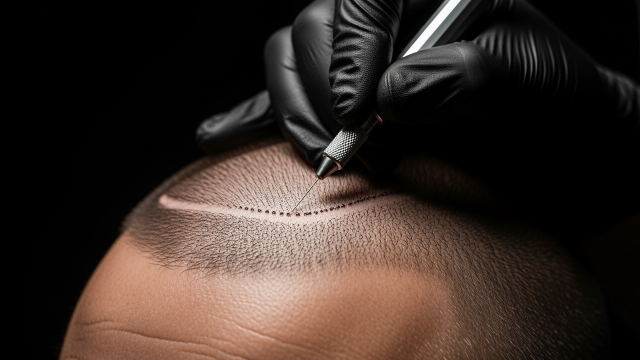
The clinic describes SMP as placing tiny pigment impressions in the scalp to create the appearance of natural hair, with a technique designed to follow the direction and thickness of existing hair rather than using simple dots alone. Candidates are people with visible thinning, receding hairlines, bald patches, widened part lines or scalp scars.
Within it there are two jobs. Medical SMP Hair Loss Care addresses broad scalp density, assessed on scalp condition, hair loss pattern and follicle distribution. SMP Hairline addresses the frontal edge, assessed with skin tone and the desired design added.
What it gives you. An immediate visible change, completed over sessions, lasting several years with maintenance.
What it does not. The clinic's approved claim is explicit: it creates the appearance of increased density and improved hairline definition and does not regrow hair.
Concern two: my hair is falling out and I want to do something about it
Different concern, different grouping. This is Hair Loss & Hair Restoration, and it starts with a question rather than a treatment.
The clinic describes its Hair Loss Diagnosis & Treatment pathway as beginning with an assessment of the pattern and severity of loss, scalp condition, medical history and possible contributing factors, with treatment selected afterward. The consultation reviews hair-loss history, family history, medications, health conditions, scalp condition and the pattern of loss.
Hair Loss Recovery Care follows for people with thinning, excessive shedding or early-stage loss who may benefit from non-surgical care, running consultation, assessment, an individualized plan, treatment sessions and follow-up monitoring.
What it gives you. A cause, and a plan aimed at the underlying process.
What it does not. Anything quick. The clinic states improvement is gradual because follicles follow growth cycles, results may take months to become noticeable, and immediate regrowth should not be expected.
The ordering rule. People with untreated scalp conditions or medical causes of hair loss requiring diagnosis and treatment first are not suitable for the cosmetic route. Diagnosis precedes appearance work.
Concern three: my face is losing firmness
This is Lifting & Skin Tightening, and it contains two energy-based options that reach different depths.
Liftera-A2 HIFU delivers focused ultrasound to the SMAS layer and underlying muscle tissue, creating controlled thermal coagulation points that stimulate collagen production, without damaging the surface skin. It offers dual line-type and pen-type applicators for broader-area and fine-detail treatment.
Laser Lifting heats the deeper layers of skin, tightening existing collagen and stimulating new, commonly used on face and neck for mild sagging and fine lines.
There is also an injectable route to the same concern — the Skin Elasticity Injection, positioned for reduced firmness and early laxity, whose candidates the clinic names as people wanting an injectable approach often alongside energy-based lifting.
What they give you. Gradual firming, developing over months as collagen remodels.
What they do not. Anything past mild-to-moderate laxity. Both energy options name that range, and the American Academy of Dermatology's material on skin tightening sets a comparable ceiling for the category.
Concern four: my skin quality has changed
Skin Rejuvenation & Regenerative Aesthetics, and here the sorting is by what specifically has changed.
Dull, dehydrated, dry-textured skin points to the Water-Glow Skin Booster, a hydration-focused injectable aimed at moisture, radiance and smoothness.
Elasticity and texture point to the Customized Skin Booster, a 1:1 treatment tailored to individual skin condition and positioned as elasticity and texture management.
A regenerative approach is the Stem Cell Aesthetic Treatment, intended to support skin rejuvenation and overall skin quality, with source, formulation, processing method and protocol determined at consultation.
What they give you. Changes in skin quality, developing progressively.
What they do not. Repositioning. None of these is a lifting treatment.
The two questions that route everything
Reading the four groupings above, two distinctions do almost all the sorting.
Appearance or biology? Do you want something to look different, or do you want to act on what is happening? SMP answers the first for hair; the hair-loss pathway answers the second. Skin boosters answer the first for skin quality in the sense of changing its properties; nothing here stops skin aging.
Quality or position? For the face specifically: has the skin itself changed, or has it moved? Quality points to the rejuvenation grouping; position points to lifting — and past a point, to something surgical that this clinic's non-surgical menu does not contain.
Almost every patient who is confused by the menu is confused because they have not answered one of those two.
What none of the four groupings contains
Worth stating plainly, because a menu describes what a clinic does and says nothing about what it does not.
Surgery. Everything above is non-surgical. Laxity past the mild-to-moderate range is a mechanical problem, and the answer to it is not on this menu.
Hair transplantation. The hair groupings cover diagnosis, supportive care and pigmentation. Relocating follicles is a different procedure.
A cure for hair loss. The diagnostic pathway can identify and address causes; nothing here stops pattern loss as a process.
Permanence. Every result on this menu is maintained rather than completed, on timescales that vary from years for pigmentation to individually-variable for the collagen-mediated ones.
Knowing the boundary of a menu is as useful as knowing its contents, because it tells you when the right answer is a referral rather than a treatment -- and a clinic willing to say so is describing its scope honestly.
Where concerns overlap
Common, and not a problem.
Hair loss plus wanting it to look denser. Both routes, in an order: diagnosis first, then pigment. The clinic's unsuitability rule makes that order mandatory rather than advisory.
Firmness plus skin quality. The clinic's own candidacy language for the elasticity injection names patients wanting it alongside energy-based lifting, and its skin boosters sit in an adjacent grouping. Sequencing is a clinical conversation.
Hairline plus crown. Two SMP jobs in one design rather than two separate plans.
What matters when concerns overlap is that the plan is made as one thing. Two plans made in separate conversations can disagree with each other.
What each grouping asks of your time
Sorting by concern tells you where to look. Sorting by time tells you what you are committing to, and for an international patient that is the more binding constraint.
Scalp micropigmentation is the only grouping that produces a visible result during the trip. It runs over multiple sessions of a few hours each, separated by healing intervals, with a review afterward. Recovery is light. The scheduling problem is fitting the sequence into a stay, not recovering from any part of it.
Hair loss diagnosis and treatment produces an answer during the trip and a result long afterward. Consultation and diagnosis can generally be completed during a clinic visit; anything aimed at the biology develops over months because follicles run on growth cycles.
Lifting and skin tightening is a single appointment whose result is not. Both energy options develop gradually as collagen remodels over months, so you will be home well before there is anything to assess.
Skin rejuvenation sits in between. The injectables are contained appointments with effects that develop progressively, and several are planned across more than one session.
Two consequences follow for planning a trip.
Only one grouping lets you leave having seen what you bought. That is not an argument for choosing it, but it changes how much you are relying on arrangements made in advance for the others.
Anything planned as a course has a question attached about where the rest happens. The clinic defers session counts to the individual plan across the menu, which means the number is knowable at assessment and not before. Ask for it early, because it is the number that decides whether a plan fits your life.
What the assessment is allowed to conclude
One property of this menu deserves stating on its own, because it is unusual enough that patients do not expect it.
Several of the clinic's pathways can conclude that the treatment you asked about is not the right one -- and in one case, that no cosmetic treatment should happen yet.
The hair-loss ordering rule is the clearest example: people with untreated scalp conditions or medical causes of hair loss requiring diagnosis and treatment first are not suitable for the cosmetic route. That is a stated refusal, published in advance.
The regenerative pathway carries a similar structure: the clinic's sequence puts determining whether the treatment is appropriate before establishing a plan.
Read those as a feature rather than an obstacle. A menu whose assessments can only say yes is not really assessing. The practical implication for you is that arriving with a described problem rather than a chosen treatment gives the assessment room to do the thing it is capable of -- which occasionally is the most valuable outcome available, and is never the outcome a yes-or-no conversation reaches.
Which concern to treat first
When more than one applies -- and for most people more than one does -- something has to go first. Three considerations decide it more reliably than preference does.
Anything with a diagnostic question attached goes first. If hair loss is one of your concerns and its cause has never been established, that assessment precedes everything, including the cosmetic work on the same scalp. The clinic's own unsuitability rule makes this mandatory rather than advisory.
Anything whose result is visible during the trip can be judged before you leave. For an international patient that is a real advantage, and it argues for putting the pigmentation work where you can assess it rather than squeezing it in last.
Anything slow should start early. A treatment whose result develops over months gains nothing from waiting, and starting it on the same trip means the clock begins while you are still in contact with the people who started it.
Those three can conflict, which is why the priority line matters. Where they do conflict, the diagnostic one wins -- it is the only one of the three that can change what the others should be.
What the treatments have in common at the assessment stage
One structural observation that makes the whole menu easier to approach.
Every pathway described above begins the same way: an evaluation of the specific thing you are complaining about, before any treatment is named. Scalp condition and hair-loss pattern for the hair work. Skin condition and treatment goals for the skin work. Anatomy and laxity for the lifting.
That consistency is useful to you because it means the preparation is also consistent. Whatever your concern, what the clinic needs from you is a description of what has changed, when it changed, and what you have noticed about when it is most visible.
That single paragraph of preparation serves every grouping on the menu, which means you can write it once and use it regardless of which concern turns out to be the one worth treating first.
What the whole menu shares
Four things true of everything above.
Assessment first. Every pathway the clinic describes starts with an evaluation, and several of them can conclude that the treatment is not appropriate.
Gradual, mostly. SMP is the exception — it shows a result immediately. Everything else develops over weeks to months.
Maintained, not completed. Pigment lasts several years with maintenance. Collagen results have longevity varying by individual. Skin boosters are described in terms of plans rather than endpoints.
Disclosed limits. Each has a stated boundary, and the boundaries are the most useful sentences in the clinic's material.
Start from the concern and the menu sorts itself
Here is the practical method, and it takes one piece of paper.
Write down what actually bothers you, in the words you would use to a friend. Not a treatment name — a complaint. "The top of my head shows in photographs." "I am finding a lot more hair in the shower." "My jaw isn't as defined as it was." "My skin looks tired by lunchtime."
Then apply the two routing questions to each one. Appearance or biology. Quality or position.
That exercise produces a short list of concerns mapped to groupings, and it does three things no amount of service-page reading does.
It reveals when you have more than one concern. Most people do, and they arrive at a consultation naming only the one they researched. A written list means the other one gets discussed rather than discovered later.
It exposes mismatches before they cost you anything. Someone whose complaint is "I am finding more hair in the shower" and whose research was entirely about pigmentation has just discovered, for free, that they were reading about the wrong grouping.
It changes what the consultation can do. A clinic given a list of concerns can propose a plan across them, in an order, with reasons. A clinic given a requested treatment can mostly say yes or no to it.
One more thing to write down: which concern would you fix first if you could only fix one. That single sentence is the most useful thing you can bring, because it tells whoever is assessing you what to optimize when the plan cannot do everything at once — and plans frequently cannot, especially when they are being fitted into a trip.
Send the list, with that priority line, through the contact page. The about page describes the practice the plan would come from, and the published before-and-after gallery is organized by category, which makes it easy to look only at the grouping your list points to.
The Bottom Line
- The menu has four non-surgical groupings; sorting them by the concern that brings you in is more useful than reading the service list.
- Two questions route almost everything: appearance or biology, and — for the face — skin quality or skin position.
- SMP answers appearance for hair and shows a result immediately; the hair-loss pathway answers the underlying process and takes months.
- Lifting addresses position within a mild-to-moderate range; the rejuvenation grouping addresses skin quality and repositions nothing.
- Write your concerns as complaints, not treatment names, and add one line saying which you would fix first.
Frequently Asked Questions
How many non-surgical groupings does the clinic have?
Four: Scalp Micropigmentation, Hair Loss & Hair Restoration, Lifting & Skin Tightening, and Skin Rejuvenation & Regenerative Aesthetics.
Which grouping do I need if my hair is thinning?
Both, potentially, in an order. Diagnosis first through the hair-loss pathway; pigmentation afterward if you want the appearance of density. The clinic will not treat over an undiagnosed cause.
What is the difference between the two SMP services?
Medical SMP Hair Loss Care addresses broad scalp density; SMP Hairline addresses the frontal edge, with skin tone and desired design added to its assessment.
Which lifting option reaches deepest?
The ultrasound option targets the SMAS layer and underlying muscle. The laser option heats the deeper layers of the skin itself.
How do I choose among the skin treatments?
By what has changed. Dullness and dehydration point to the hydration-focused booster; elasticity and texture to the customized one; the regenerative option is its own category with more deferred to consultation.
Can I address more than one concern?
Yes, and it is common. What matters is that overlapping concerns are planned as one design rather than in separate conversations that can disagree.
What does the whole menu have in common?
Assessment first, gradual development except for SMP, results that are maintained rather than completed, and a stated limit for each.
What should I bring to a consultation?
Your concerns written as complaints rather than treatment names, plus one line saying which you would fix first if only one were possible.
This article is for general informational purposes and does not constitute individualized medical advice. It is not a self-diagnosis tool. Which treatments suit your concerns can only be determined through a consultation with a qualified dermatologist or other appropriately qualified clinician who has assessed you in person.
More Articles
Continue reading our clinical guides.

Return Clinic's Non-Surgical Options Compared by Concern
Return Clinic's Non-Surgical Options Compared by Concern Medically reviewed by Dr. Hyung Geon Kim, M.D., Ph.D., Board-Certified Internal Medicine Specialist A clinic menu is organized by what the clinic does.
Learn More
SMP scalp tattoo guide to Korea from Beijing: Guide to appointments, face-to-face consultations and return journeys
北京去韩国做SMP头皮纹发:行程、预约与术后返程规划 医学审核 Dr. Hyung Geon Kim, 医学博士,内科专科医师 要点总结 京首双城短途直飞优势 :从北京首都国际机场或北京大兴国际机场出发,直飞首尔金浦国际机场或仁川国际机场的航程仅需约两小时左右;这一便捷的交通条件使 北京去韩国做SMP 成为周末短途或小长假出行的可行选择。
Learn More

Is Scalp Micropigmentation Painful? A Straight Answer
Is Scalp Micropigmentation Painful? A Straight Answer Medically reviewed by Dr. Hyung Geon Kim, M.D., Ph.D., Board-Certified Internal Medicine Specialist Pain is near the top of what US patients ask Return…
Learn More