Personalized Medical Care & Dedicated International Patient Concierge

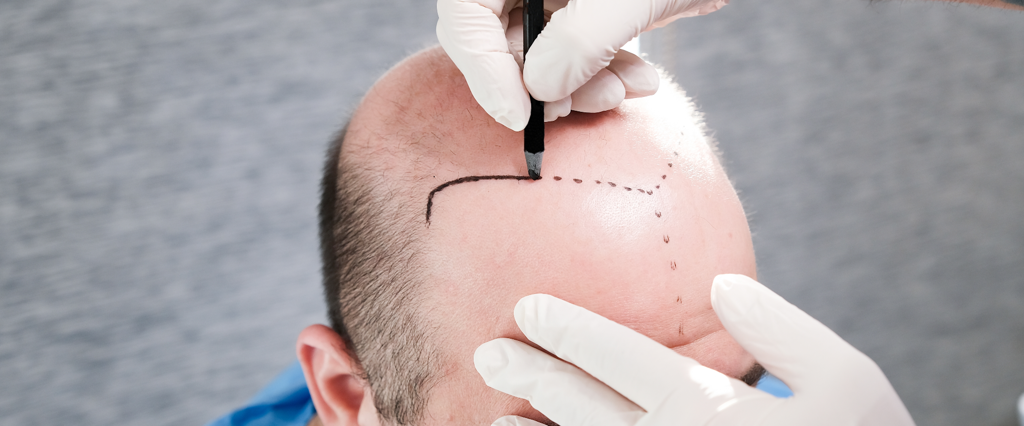
Medical Guide
SMP Hairline vs Men's SMP Hairline: What's the Difference?
SMP Hairline vs Men's SMP Hairline: What's the Difference? Medically reviewed by Dr. Hyung Geon Kim, M.D., Ph.D., Board-Certified Internal Medicine Specialist Return Clinic lists two hairline services, and the…
Schedule a ConsultationSMP Hairline vs Men's SMP Hairline: What's the Difference?
Medically reviewed by Dr. Hyung Geon Kim, M.D., Ph.D., Board-Certified Internal Medicine Specialist
Return Clinic lists two hairline services, and the second one's name makes the difference sound obvious. It is not quite as obvious as it looks, and the distinction that matters is not really about who you are.
It is about what shape your hairline has lost.
What the clinic says about each
SMP Hairline is described as a scalp micropigmentation service focused specifically on redesigning or restoring the hairline — used to soften a receded hairline, define an irregular hairline shape, or camouflage a visibly thinning frontal edge. Its candidates are adults with hairline recession, thinning hair, scalp scars, or those seeking a shaved-hair appearance, and its process runs consultation, hairline design, pigment color matching, micropigmentation sessions, then aftercare.
Men's SMP Hairline is described as creating the appearance of a natural hairline and fuller-looking hair, with a process that begins by mapping male-pattern recession and designing an age- and face-shape-appropriate hairline, then pigment matching, strand-pattern application, a healing interval, and review or touch-up.
Read the two process descriptions side by side and the difference is in the first step. One begins with hairline design. The other begins with mapping male-pattern recession and then designing.
The distinction is a pattern, not a gender
Male-pattern recession has a specific geography. The corners above the temples withdraw first and furthest; a central peak persists; the result is the familiar M. It is progressive, it follows a recognizable course, and a design that ignores where it is heading ages badly.
A hairline that has lost that particular shape needs a design built around it — which is what the mapping step in the men's service is for, and why the clinic specifies an age- and face-shape-appropriate line rather than simply a requested one.
A hairline that is thinning without that geography is a different design problem. There are no corners to reckon with and no characteristic trajectory to defend against; the work is about the edge as it actually presents.
So the sorting question is not "am I a man". It is "does my hairline show male-pattern recession". Those correlate strongly and they are not the same question, which is why the more general service exists alongside.
Where the general service fits
The broader SMP Hairline service covers situations the pattern-specific one is not shaped for.
Diffuse frontal thinning. The edge is still roughly where it was, but it has become sparse and indistinct. The job is definition rather than repositioning.
An irregular hairline. The clinic names defining an irregular hairline shape among the service's purposes. Irregularity can come from how a hairline grew, from scarring, or from previous work.
Scalp scars at the front. Named explicitly among the candidates.
A shaved-hair appearance. Also named. Someone whose plan is a closely shaved head is asking for a front edge consistent with that look, which is a different design target from restoring the appearance of longer hair.
Female pattern thinning at the front. Hair loss in women commonly presents as widening at the part and diffuse thinning rather than as corner recession — the American Academy of Dermatology publishes on female pattern hair loss and the distinction is clear in its material. A hairline affected that way is not a male-pattern problem regardless of anything else.
What both share
More than the names suggest.
Both are pigmentation, and the clinic's approved claim applies to both: its SMP work creates the appearance of increased hair density and improved hairline definition and does not regrow hair.
Both use the clinic's stated technique of following the direction and thickness of existing hair rather than relying on uniform dots. Both match pigment before applying it. Both run over sessions whose count and timing vary with scalp condition and area. And both carry the same disclosed effects — temporary redness, mild discomfort or pigment fading, with most patients resuming normal activities shortly after.
Both also share the clinic's unsuitability criteria: active scalp infections, certain skin conditions, unrealistic expectations, and the standing requirement that an untreated medical cause of hair loss is diagnosed first.
What the mapping step actually produces
Since the presence or absence of a mapping step is the structural difference between the two services, it is worth knowing what it is for.
Mapping male-pattern recession means establishing the geography of the loss before deciding anything: how far the corners have gone, how much central peak remains, where the boundary between the two sits, and how densely hair grows at that boundary.
That last item is the one that quietly determines quality. A hairline design has to meet real hair somewhere, and the transition is where a result either reads naturally or announces itself. Mapping records where that meeting will happen before a line is proposed, rather than discovering it during application.
For a hairline without pattern geography, there is less to map and more to look at: the edge as it presently sits, how sparse it has become, and what shape would suit the face. The design work is no less careful; it is simply anchored on the present rather than on a trajectory.
Neither approach is more thorough. They gather different evidence because they are solving different shapes of problem.
The design question that applies either way
Whichever service applies, one decision dominates: where the line goes.
The men's service names an age- and face-shape-appropriate hairline as its design target. That framing is worth borrowing regardless of which service you end up in, because the failure mode is identical. A line placed to recreate a much younger hairline looks best on the day it is finished and worse every year afterward, as the face continues to change and the pattern behind it continues to move.
Pigment marks a position. It does not hold the hair behind that position. Any hairline design is therefore a bet on where things will be in a decade, and the conservative bet is the one that ages into a plausible result rather than out of one.
What to send, either way
Because the presentation determines the service, what you send determines how quickly the right one is identified.
Photographs straight on, in ordinary daylight. Not overhead light, which exaggerates scalp visibility, and not a bathroom mirror selfie, which distorts the hairline's shape.
Photographs from each side. Corner recession is much clearer in profile than from the front, and it is the feature that separates the two services.
One from above. Not because it shows the hairline, but because it shows whether the crown is also involved -- which changes the conversation from a hairline question into a combined one.
Your hair pushed back. A hairline photographed with hair falling over it is a photograph of your hair, not your hairline.
A sentence about how you want to wear it. A design appropriate for hair worn longer is not the same as one appropriate for a closely shaved head, and the target length is a specification rather than a detail.
That set takes five minutes and it is the difference between a first reply that identifies your presentation and one that asks for better pictures.
When the general service is the right one
Here is the practical resolution, and it is simpler than the two-service framing suggests.
You are not really choosing. You are describing, and the description determines which service the clinic applies. But there is a version of this decision where patients get it wrong on their own before they ever make contact, and it is worth naming.
The mistake is assuming the pattern-specific service is the more advanced one — that "Men's" denotes a premium version and the general service is the basic tier. It does not. They are shaped for different presentations, and applying the male-pattern design logic to a hairline that has not receded in that pattern produces a worse result, not a more sophisticated one.
Three situations where the general service is straightforwardly the right answer, even for a man:
Your hairline is thinning evenly rather than retreating at the corners. There is no M to map. The design problem is definition, and mapping a pattern you do not have adds nothing.
Your hairline is irregular for a reason other than pattern loss — a scar, an unusual natural shape, or previous work that needs correcting. Here the existing edge is the design constraint, not a predicted trajectory.
You want a shaved-head hairline. The target is a front edge consistent with very short hair, which is its own specification and is named among the general service's purposes.
And one where it is not: an established M-shape with temple recession. That is what the pattern-specific mapping exists for, and the general service would have to reinvent it.
The instruction that follows from all of this is short. Do not select a service. Photograph your hairline straight on and from each side in ordinary daylight, say what you want to be able to wear your hair like, and let the clinic tell you which of its two processes your hairline calls for. That is the sequence that gets it right, and it is the one that costs you nothing to follow.
Send the photographs and that one sentence about how you want to wear your hair through the contact page. The before-and-after gallery is organized by category and is a useful calibration before you write.
The Bottom Line
- The difference is the shape your hairline has lost, not your gender — Men's SMP Hairline begins by mapping male-pattern recession, the general service begins with hairline design.
- The general service covers diffuse frontal thinning, irregular hairlines, frontal scarring, shaved-head hairlines, and thinning that does not follow male-pattern geography.
- Neither is a premium version of the other; applying male-pattern design logic to a hairline without that pattern produces a worse result.
- Both are pigmentation under the same approved claim, use the same stated technique, and carry the same unsuitability criteria.
- Do not pick a service — send photographs and a sentence about how you want to wear your hair, and let the presentation decide.
Frequently Asked Questions
What actually separates the two services?
The starting point of the process. The men's service begins by mapping male-pattern recession before designing; the general service begins with hairline design for the edge as it presents.
Is the men's service only for men?
It is shaped for male-pattern recession, which is a pattern rather than a demographic. The relevant question is whether your hairline shows corner recession, not who you are.
Which service suits female pattern thinning?
Female pattern hair loss commonly presents as widening at the part and diffuse thinning rather than corner recession, which is the general service's territory.
Is Men's SMP Hairline more advanced?
No. They are shaped for different presentations. Applying male-pattern design logic to a hairline that has not receded that way adds nothing and can make the result worse.
What if I want a shaved-head look?
That is named among the general service's purposes. A front edge consistent with very short hair is its own design target.
Do they use different techniques?
Both use the clinic's stated approach of following the direction and thickness of existing hair rather than uniform dots, and both match pigment before applying it.
Do either of them regrow hair?
No. The clinic's approved claim for its SMP work is that it creates the appearance of increased density and improved hairline definition and does not regrow hair.
How do I choose between them?
You do not. Send photographs straight on and from each side, say how you want to wear your hair, and let the clinic identify which process your hairline calls for.
This article is for general informational purposes and does not constitute individualized medical advice. It is not a self-diagnosis tool. Hairline design and service selection can only be determined through a consultation with a qualified dermatologist or other appropriately qualified clinician who has examined your scalp in person.
More Articles
Continue reading our clinical guides.
Return Clinic's Non-Surgical Options Compared by Concern
Return Clinic's Non-Surgical Options Compared by Concern Medically reviewed by Dr. Hyung Geon Kim, M.D., Ph.D., Board-Certified Internal Medicine Specialist A clinic menu is organized by what the clinic does.
Learn More
SMP scalp tattoo guide to Korea from Beijing: Guide to appointments, face-to-face consultations and return journeys
北京去韩国做SMP头皮纹发:行程、预约与术后返程规划 医学审核 Dr. Hyung Geon Kim, 医学博士,内科专科医师 要点总结 京首双城短途直飞优势 :从北京首都国际机场或北京大兴国际机场出发,直飞首尔金浦国际机场或仁川国际机场的航程仅需约两小时左右;这一便捷的交通条件使 北京去韩国做SMP 成为周末短途或小长假出行的可行选择。
Learn More

Is Scalp Micropigmentation Painful? A Straight Answer
Is Scalp Micropigmentation Painful? A Straight Answer Medically reviewed by Dr. Hyung Geon Kim, M.D., Ph.D., Board-Certified Internal Medicine Specialist Pain is near the top of what US patients ask Return…
Learn More