Personalized Medical Care & Dedicated International Patient Concierge


Medical Guide
Men's SMP Hairline: Temple Recession and M-Shaped Hairlines
Men's SMP Hairline: Temple Recession and M-Shaped Hairlines Medically reviewed by Dr. Hyung Geon Kim, M.D., Ph.D., Board-Certified Internal Medicine Specialist \"Can you treat an M-shaped hairline?\" sits near…
Schedule a ConsultationMen's SMP Hairline: Temple Recession and M-Shaped Hairlines
Medically reviewed by Dr. Hyung Geon Kim, M.D., Ph.D., Board-Certified Internal Medicine Specialist
"Can you treat an M-shaped hairline?" sits near the top of the questions Return Clinic records from US patients. It is a good question and it has a more interesting answer than yes.
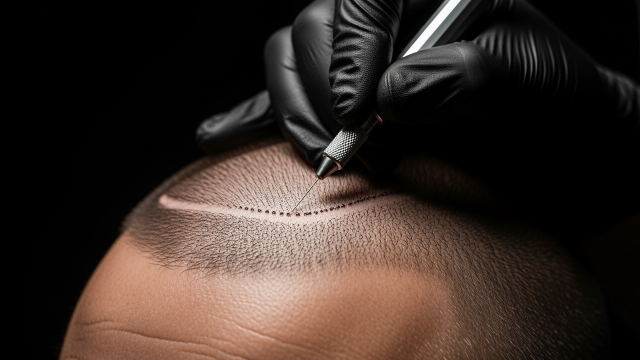
Yes, the shape can be addressed. But the decision that determines whether you are satisfied in ten years is not whether the temples can be filled — it is where the new line is placed and how it is shaped. Return Clinic's stated process names that directly: consultation maps male-pattern recession and designs an age- and face-shape-appropriate hairline, then pigment is matched, strand-pattern application follows, then a healing interval, then review and touch-up.
Every consequential word in that sentence is in the first step.
What male-pattern recession actually does
Hair loss in men does not thin the front edge evenly. It withdraws in a characteristic geography: the corners above the temples retreat first and furthest, leaving a central peak that holds longer. That is what produces the M.
Two features of that pattern matter for design.
It is asymmetric by region, not by side. The recession is deeper at the corners than in the middle, which means a hairline drawn as a straight line across would be inventing a shape that no natural hairline has.
It keeps moving. The pattern is progressive. Where it sits today is a point on a path rather than a destination, and the American Academy of Dermatology's material on male pattern hair loss describes that trajectory in useful detail.
Design that ignores the second point produces a result that ages badly. This is the whole reason the clinic's process specifies an age-appropriate line rather than simply a requested one.
Mapping before designing
Mapping is the step patients skip in their imagination, because it produces nothing visible.
Return Clinic's stated process begins by mapping the male-pattern recession — establishing where the loss actually is, what shape it has taken, and how the remaining hair sits at the boundary. Its broader SMP material adds what the assessment covers generally: scalp condition, hair-loss pattern, skin tone, and the desired design.
That last item is listed alongside the others rather than above them, which is the correct relationship. Your preference is one input among several, not the specification.
Mapping also establishes the boundary condition that governs everything else: where your own hair currently ends and how densely it ends there. A pigmented hairline is only convincing where it meets real hair convincingly, and a transition that is too abrupt reads as a line drawn on a head regardless of how well the individual impressions were placed.
Why the lowest line is the wrong target
Most men arrive wanting the hairline they had at twenty. It is worth being direct about why that is usually a mistake, and the reasons are not about restraint for its own sake.
A hairline sits in a face, and the face changed too. A line appropriate to a twenty-year-old face looks different on a forty-year-old one. The clinic's specification of a face-shape-appropriate design is pointing at exactly this — the line has to relate to the proportions it sits in now.
The loss behind it continues. Pigment marks where the hairline is placed. It does not hold the position of the hair growing behind it. If the line is placed well forward of where recession has reached and the recession then continues, you can end up with a pigmented front edge and a gap opening behind it. A line placed in a defensible position ages with the pattern instead of against it.
Recreating a juvenile hairline reads as recreation. A natural adult hairline has some recession at the corners. Filling the M completely to a straight low line removes the feature that tells a viewer this is a normal hairline.
None of this means the line must be high or timid. It means the target is a hairline appropriate to you, which is a different specification from the lowest one achievable.
Softening rather than erasing
The productive way to think about an M-shaped hairline is reducing how sharply it reads rather than abolishing it.
The corners are where a viewer's eye registers recession, because the contrast between bare temple and dense hair is at its strongest there. Pigment placed into the corners lowers that contrast: the boundary stops being an edge and becomes a gradient. The M is still present in the underlying geometry and it stops announcing itself.
This is also the approach that ages well, because it does not depend on holding a position. A softened corner that recedes slightly further remains a softened corner. A hard line that recedes becomes a hard line in the wrong place.
Where the temples fit
Temple recession gets its own attention because it behaves differently from the frontal edge.
The temple region has its own natural shape, its own hair direction, and hair that is typically finer than the hair further back. A design that treats the temple as simply more frontal hairline produces a blunt corner that no hairline has.
Two things follow practically. The direction of application matters more here than almost anywhere, because temple hair angles differently and pigment placed at the frontal angle will look wrong against it. And density has to taper, because a temple filled to frontal density reads as a block.
This is where Return Clinic's stated technique — reproducing the direction and thickness of individual hair strands rather than relying on dots — has the most work to do, and it is a reasonable thing to ask about specifically when you look at a clinic's published results.
Who it suits, and who should be assessed first
The clinic names candidates plainly: individuals with a receding hairline, thinning hair, or visible scalp who want a non-surgical cosmetic improvement.
It is equally clear about who should not proceed yet. Individuals with active scalp infections, certain skin conditions, or unrealistic expectations should undergo professional assessment before treatment. And the clinic's broader hair-loss material states that people whose hair loss has an untreated medical cause requiring diagnosis and treatment are not suitable candidates.
Unrealistic expectations appearing on a medical unsuitability list is worth pausing on. It is not a comment about the patient. It is a recognition that a procedure aimed at an unachievable target has a poor outcome designed into it before anyone starts.
What to expect afterward
The clinic describes temporary redness, mild discomfort, or pigment fading as possible, with most patients able to resume normal activities shortly after treatment. Aftercare is following the clinic's guidance to support pigment retention and healing.
On durability, the clinic states the procedure offers improved effectiveness and longevity compared with conventional semi-permanent scalp pigmentation. Read that as a comparative claim about how long pigment holds, not as permanence — the process includes a review and touch-up step precisely because retention varies.
The pattern underneath, meanwhile, continues on its own schedule. That is not a flaw in the work; it is the reason the design decision at the start is the one that determines how the result looks years later.
Combining it with broader coverage
The clinic notes that Men's SMP Hairline is often paired with Medical SMP Hair Loss Care for men who have both hairline recession and broader crown thinning.
That pairing is worth understanding as two different jobs rather than one larger one. The hairline is a shape problem solved by design. The crown is a density problem solved by matching. A man who has both and treats only the front can end up with a well-defined hairline in front of a thinning crown, which draws attention to the crown rather than away from it.
Raise both at assessment if both apply, and ask how they would be sequenced.
The hairline you will still want at fifty
Here is the test worth applying to any proposed design, and it is the one that separates a good outcome from a regretted one.
Do not ask whether you like the line now. Ask what it will look like when the pattern behind it has moved on another decade — because it will, and the pigment will not move with it.
A line designed against that future has particular properties. It sits where recession has plausibly settled rather than where it began. It keeps some corner recession, because a hairline with none looks like a hairline that was drawn. It tapers at the temples rather than ending in a corner. And it meets your real hair gradually enough that the transition survives the hair behind it getting thinner.
A line designed against the past has the opposite properties, and it looks best on the day it is finished. That is the trap, because the day it is finished is the day you judge it — in the clinic, in good light, against a memory of how you looked before. The comparison that actually matters happens years later, in a mirror at home, and nobody is there to make the case for the more conservative line.
So make that case to yourself before you go. Bring a photograph of yourself at thirty rather than at twenty. Ask the clinic what line it would recommend if you never had another treatment, and treat a recommendation more conservative than your instinct as evidence of judgment rather than reluctance. The clinic's own process already specifies an age- and face-shape-appropriate hairline; your part is not to argue it down.
Start that conversation through the contact page with photographs of your hairline in ordinary light, straight on and from each side. The before-and-after gallery is the place to calibrate what a softened corner actually looks like, which is easier to see than to describe.
The Bottom Line
- The clinic's process maps male-pattern recession first, then designs an age- and face-shape-appropriate hairline before any pigment is matched or applied.
- The goal with an M-shaped hairline is softening how sharply the corners read, not erasing the shape — a natural adult hairline has some corner recession.
- The lowest achievable line is the wrong target: the face has changed, the recession behind it continues, and a juvenile line reads as recreated.
- Temples need their own direction and a tapering density; treating them as more frontal hairline produces a blunt corner.
- Judge a proposed design by what it will look like in a decade, not on the day it is finished.
Frequently Asked Questions
Can an M-shaped hairline be treated?
The shape can be addressed. The realistic aim is reducing how sharply the corners read rather than filling them to a straight line, because a natural adult hairline retains some corner recession.
How does the clinic decide where the new hairline goes?
Its stated process maps the male-pattern recession, then designs a hairline appropriate to your age and face shape, before pigment matching and application.
Why not restore the hairline I had at twenty?
Because your face has changed, the recession behind the line continues after treatment, and a fully filled juvenile line reads as artificial. A defensible position ages with the pattern.
What is different about the temple area?
Temple hair angles differently and is typically finer, so pigment there needs its own direction and a tapering density. Applied at frontal angle and density it produces a blunt corner.
Who should not have this yet?
Anyone with an active scalp infection or certain skin conditions, anyone with unrealistic expectations, and anyone whose hair loss has an untreated medical cause needing diagnosis first.
What happens after treatment?
Temporary redness, mild discomfort or pigment fading may occur, and most patients resume normal activities shortly afterward. Aftercare guidance supports pigment retention and healing.
Should I treat my crown at the same time?
Ask at assessment. The clinic notes that the hairline service is often paired with its density-focused service for men who have both, and treating only the front can draw attention to an untreated crown.
How long will it last?
The clinic describes improved longevity compared with conventional semi-permanent scalp pigmentation, and the process includes a review and touch-up step because pigment retention varies between people.
This article is for general informational purposes and does not constitute individualized medical advice. It is not a self-diagnosis tool. Hairline design, candidacy and expected outcomes can only be determined through a consultation with a qualified dermatologist or other appropriately qualified clinician who has examined your scalp in person.
More Articles
Continue reading our clinical guides.

Return Clinic's Non-Surgical Options Compared by Concern
Return Clinic's Non-Surgical Options Compared by Concern Medically reviewed by Dr. Hyung Geon Kim, M.D., Ph.D., Board-Certified Internal Medicine Specialist A clinic menu is organized by what the clinic does.
Learn More
SMP scalp tattoo guide to Korea from Beijing: Guide to appointments, face-to-face consultations and return journeys
北京去韩国做SMP头皮纹发:行程、预约与术后返程规划 医学审核 Dr. Hyung Geon Kim, 医学博士,内科专科医师 要点总结 京首双城短途直飞优势 :从北京首都国际机场或北京大兴国际机场出发,直飞首尔金浦国际机场或仁川国际机场的航程仅需约两小时左右;这一便捷的交通条件使 北京去韩国做SMP 成为周末短途或小长假出行的可行选择。
Learn More

Is Scalp Micropigmentation Painful? A Straight Answer
Is Scalp Micropigmentation Painful? A Straight Answer Medically reviewed by Dr. Hyung Geon Kim, M.D., Ph.D., Board-Certified Internal Medicine Specialist Pain is near the top of what US patients ask Return…
Learn More